
On January 1st, people around the world vow to change themselves in the new year, often to improve their health, their minds, or their appearances. For many, the start of a new year provides a clean slate, so people can take steps forward without being held back by the past. Yet, time after time, these resolutions fall to the wayside as the year progresses.
The time-honored tradition of New Year’s resolutions has roots in ancient religious practices, dating back nearly 4,000 years. Originally, resolutions were vows of greater devotion and repentance, promising that people would become better than they had been.
Today, these resolutions are far more personal. According to the Pew Research Center, New Year’s resolutions most commonly concern health, diet, or exercise (79%). Other popular topics include finance, relationships, hobbies, and careers.
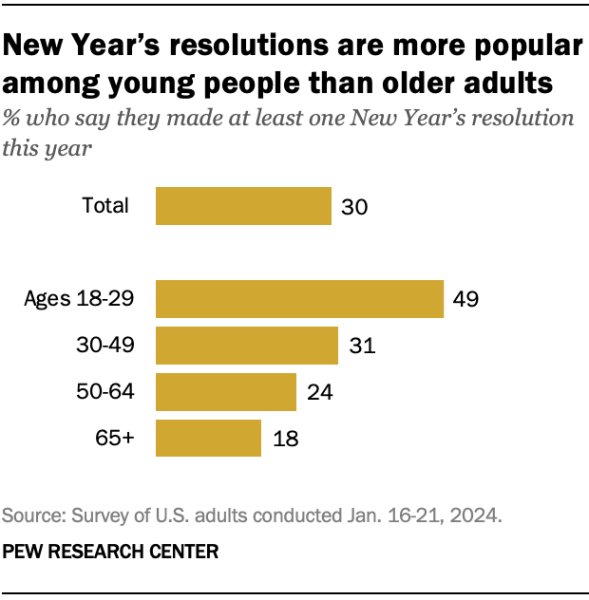
Though resolutions are personal ventures for the new year, many don’t subscribe to them at all. Only 30% of adults set New Year’s resolutions for 2024. Shockingly, young adults make up the majority of resolution-setters. Of that 30%, 49% were aged between 18 and 29, a stark contrast to the mere 18% that adults over 65 make up. Reasons for this may be that young adults are in an influential and tumultuous time of their lives. These individuals rarely have lots of stability in their lives, so clear goals, such as resolutions, help guide them forward.
Unfortunately, New Year’s resolutions are notorious for failing. Many make grand goals with little to no plan or discipline, causing them to fizzle out as soon as they become too difficult. In fact, the second Friday in January is unofficially known as “Quitter’s Day,” where people lose their resolutions and return to old habits. According to a 2024 study by Forbes Health, the majority of people lose their resolutions between two to three months into the year, while six percent maintain theirs throughout.
To keep up with New Year’s resolutions, it’s important to choose only one or two small, specific, and manageable goals. That way, they don’t interfere too much with well-established routines and become easier to incorporate into daily life.
With the right mindset, any goal is achievable. Although they can be set at any time of the year, New Year’s is often the perfect time to bring new habits to daily life, even with its reputation. No matter what it may be, as long as it is approached with appropriate expectations, resolutions may prove to be more effective than ever.