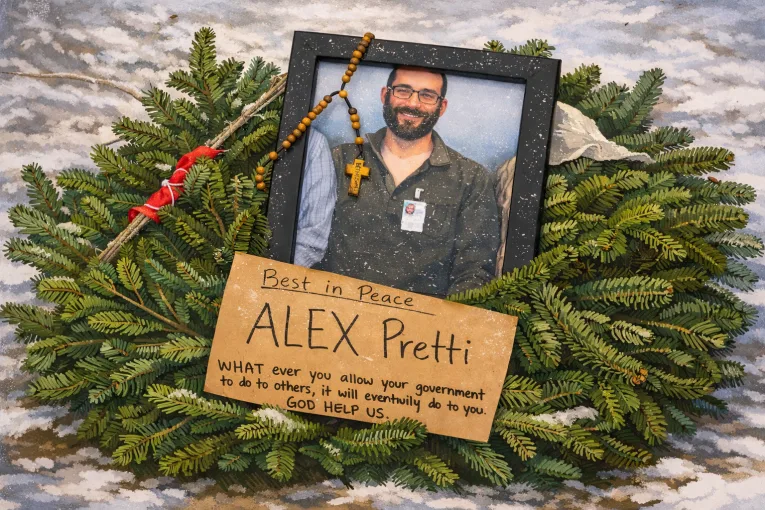
Federal officials are revising their initial description of Minneapolis ICU nurse Alex Pretti as a “domestic terrorist” amid new video evidence and changing statements raising questions about a deadly encounter with immigration agents. This story highlights a broader pattern observed by classmates and me at Rangeview: how power dynamics, accountability, and media narratives unfold during crises, often overshadowing facts and impacting lives.
Pretti, a 37-year-old nurse, was shot and killed by immigration agents in Minneapolis on January 24. Video footage has prompted a Justice Department civil rights investigation and criticism of the Trump administration’s use-of-force policies. Our Rangeview podcast previously discussed similar incidents, emphasizing frustration over delayed accountability.
The footage shows an immigration agent shoving a woman, with Pretti stepping in to protect her. Despite carrying a firearm, no video shows Pretti reaching for it, and federal policy restricts deadly force to imminent threats. This discrepancy echoes concerns about how quickly terms like “violent” or “terrorist” are applied, especially to people of color and protesters, before the full story is known.
The debate also centers on evidence control and investigation transparency. A federal judge recently ended an order to preserve all scene materials, citing sufficient existing policies. Meanwhile, agencies like the FBI and Homeland Security have withheld evidence, fueling public skepticism about the investigation. As a student journalist, I wonder: if the system is fair, why is evidence still hidden?
Footage showing a federal agent disarming Pretti before shots were fired has raised questions about tactics and professionalism. The incident follows a recent confrontation where Pretti was seen kicking a federal vehicle’s taillight before being tackled and released. This pattern illustrates how minor challenges to authority can escalate and lead to automatic threats perceived by officials.
Initially, top Trump officials framed the shooting as domestic terrorism. Homeland Security Secretary Kristi Noem claimed Pretti wanted to harm officers. Others called him a “terrorist” or accused him of an attempted “massacre.” This reflects how quickly the government labels suspects, often before investigations conclude. While investigations usually take weeks or months, under the Trump administration, many cases, including the recent fatal shooting of Renee Good by ICE, were cleared within days. To many at Rangeview, this looks less like decisive leadership and more like the system protecting itself.
Given this, I invite my classmates to think about how language used by powerful figures shapes public perception and the pursuit of justice. How does the swift use of labels like “terrorist” or “threat” affect the narrative and our understanding of events? I encourage everyone to reflect on these questions and consider how we can more critically engage with the stories presented to us.
Some officials who once spoke with certainty are now softening their positions. Spokesman Miller says the White House is reviewing whether the Customs and Border Protection team “may not have been following” proper protocol. He says extra personnel sent to Minnesota were supposed to focus on fugitive operations and form a barrier between arrest teams and protesters, suggesting agents may have strayed from that plan. The pattern is familiar: strong words to justify force, followed by careful walk-backs once video and public pressure make the story harder to control.
Noem defends her early language by saying she relied on confusing initial reports and that officials should share as much as they can from the first briefings. She now promises her department will “do better” as new evidence appears. On our Rangeview podcast, we asked what real “better” looks like after lives are lost: softer words next time, or bigger changes in training, transparency, and whose voices are heard.
Behind these statements lies a deeper issue: accountability. Federal law enforcement sources told CNN that without clear video, it can be extremely hard to challenge an agent’s account. One source warned that if it is “the ICE agent’s word against someone else,” agents are “basically untouchable” unless the conduct is both extreme and on film. That reality is one reason our podcast keeps returning to phones and cameras—how, for our generation, “pull out your phone” has become almost a survival instinct around law enforcement.
For many observers, the killing of Alex Pretti shows how bystander videos increasingly shape public understanding of police and federal actions. It also raises questions about how quickly officials should speak after violent incidents—and whether their early claims are based on facts or assumptions that later collapse. At Rangeview, we imagined what it would look like if officials had to wait for verified evidence before going on TV, the way students must gather reliable sources before turning in a research paper or a story for the Raider Review.
As the Justice Department’s civil rights investigation continues, the case will likely remain a flashpoint in debates over immigration enforcement, transparency, and the use of force in American cities. For me, it is also a reminder that national headlines connect directly to the questions we ask at Rangeview—on our podcast, in classrooms, and in hallways—about who is protected, who is believed, and what justice is supposed to look like in real life, beyond a press release.